Imagine:
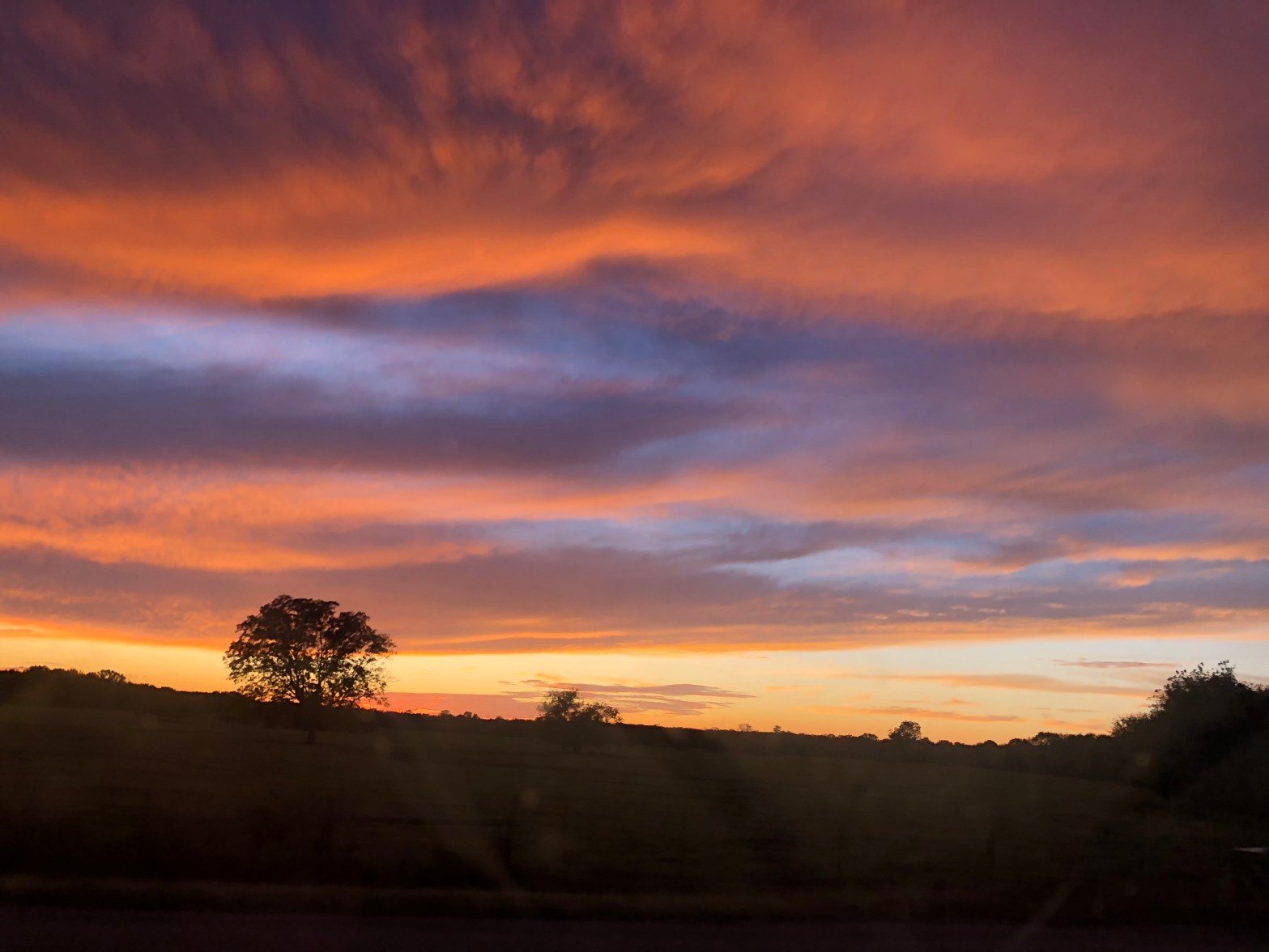
A car effortlessly flies down the road, crests one hill then another, no others in sight. The windows are rolled down, outside noise bombarding in as the wind and world collectively rush by. Meanwhile, the sun sinks in the sky, washing everything in a wonderous, blazing light. Maybe music is coming from the stereo – you know the song – probably some crooning country one that perfectly matches and pulses with the golden-hour countryside yet somehow doesn’t disrupt the peace offered by the beauty.
Who is the driver? Is it the heartbroken rom-com character, trekking across the country to get the love of their life back? The sultry but unwilling to admit it prodigal son? The best friend, the one who effortlessly throws a smile over their shoulder to the passenger? Is it you, seamlessly moving at the speed of the song, of life, toward what’s next?
Or, is it life itself?



As of late, I have become a big movie-watcher. Usually, I turn on a rom-com, but honestly, give me a good story – some laughs, maybe a few tears, an inspirational quote or two, and a good glass of red wine – and I’ll sit pretty content. The thing about most movies is they have exactly that scene, the memorable climax where emotions seemingly pour from the television screen – can you picture it, feel it? Does one come to mind?
Time at this point in the movie moves at an incredible pace, the speed of a song, really, and by the end of that song, the character arrives at their destination. Well, I am almost always listening to music – and driving – and I can assure you, this phenomenon has never happened to me. What is it with movies, or maybe even the 300-some odd pages of that young adult novel you’ve recently been absorbed in, depicting an unfathomable, yet desirable, turning of time? Perhaps these media aim to subtly remind us
with time, everything will work out,
whatever it is, this too shall pass,
and even – “this is your moment, live now.”
I get caught up thinking about “movie time.” Sometimes I have a moment, one where I’ve looked up – and stopped – and fleetingly recognized I’ve let time do too good a job of passing time. And I wonder.
“Is this my movie moment? Is this that golden-hour, windows rolled down, hair blowing in the wind, time-racing-at-the-speed-of-the-song scene I have always longed for?”
Only to realize seconds later, it is, in fact, not.
The actuality of these moments is that I realize life – mine, yours, everyone’s – is merely a series of memories, exclamations, and epiphanies, all connected by the stresses, joys, frustrations, annoyances, jubilations, and realizations experienced as a result of merely “having a day.” And we get a new chance each day to find our movie climax, even if it is the smallest moment – good or bad – to remind us each day is distinguishable from the next. Because when I, you – we – look back the next day, week, year, decade….we will all find and relive the movie scene memories of our lives.
I suppose by now I have you highly confused, what with movie scenes and time and rolling country sides at golden hour…I have a point, I promise.
Is this that golden-hour, windows rolled down, hair blowing in the wind, time-racing-at-the-speed-of-the-song scene I have always longed for?
At the core, I truly aim for this work to be an exploration of happiness; selfishly, I suppose, mainly mine. For months, I have been thinking about the idea of a theory of everything, except on happiness (duh). My brother, an incredibly logical person (read: 🙄), aptly described my idea back to me by saying, “So basically, you’re gonna look at all things that matter to people but also don’t really matter at all? Well, I guess that’s cool, but I think philosophy is kind of dumb.”
Gee, tell me how you really feel, Trevor. I guess that’s why opinions are personal – everyone has one, and you can choose to listen, or not, or store it away as a reminder that not everything is everyone’s thing.
But back to my happiness monologue. I have two main points, but they are so intertwined, the start of one and the end of the other get lost in the mix.
1 All my life I have been a fairly reliable happy-go-lucky person. Once, my friends even awarded me the title “Biggest Ray of Sunshine.” Likely in part because a lot of the time I find it hard not to smile in delight when all I’ve done is merely walked outside to be greeted by the beaming sun and beautiful day. Often, others around me seem to rely on this steady stream of upbeat energy.
But, hey, friends, listen. Life can be pretty hard, and I know it is impossible to be happy at absolutely all times. We have hardships. Maybe they are emotional hardships with friends, family, or significant others. Maybe we all survive a pandemic. Maybe there was a natural disaster. Or maybe, you’ve just woken up on the wrong side of the bed and you need a simple reminder that today is going to work out and good things still exist.
Happiness is not simply some end state of being. It. Is. Fickle. Yet, it is also
Uplifting.
Overwhelming.
Fluctuating.
Liberating.
Nostalgic.
Bittersweet.
Whimsical.
Emotional.
Sad.
Rewarding.
It is so many things, and if someone – like myself, perhaps – who is often known to be happy, needs to hear it is a journey, and it is okay to not always be happy, then I am here to tell me – and you – that.
I’ve previously heard happiness described as the joy experienced as a result of working diligently toward something you love.1 I’d like to take it a step forward, or maybe, a step in another direction:
Happiness is a by-product of a value-driven life, and it is these values that guide the thoughts, choices, and actions of our everyday lives.
Added together, these moments build and build and build, until suddenly you look back and see the good work, see the movie of your life, spread before you on the sunset-spotlighted highway.
So that’s point one – happiness is what you find when you choose to live by your values, intangible yet powerful conceptions that will push, guide, and remind you it’s all going to be alright.
Maybe you read that last line and you thought, “YES.” But maybe you’re a skeptic.
“How in the world is this girl going to sit here and tell me it’s going to be alright? She doesn’t even know me.”
You’re right, I don’t know you. But I do fully ascribe to the ideal that with a little bit – or a lot – of hard work, things will work out, and here’s why:
2 For a lot of my life, I have heard people say – in response to my unfailingly idealistic, “It’ll work out!” – “well yeah, it would work out for you, you’re Jade.”
I would not say this statement makes me angry or confused, but perhaps a little sad. I believe in myself, my abilities, my values, if you will, and my voice to get me to where I need to be. Sure, I have spirituality and religion and just a whole lot of faith in the inherent goodness of the world on my side. But at the end of the day, I am successful because I believe in myself and I believe in good things. And you need to as well.
You are a person who will make a difference in your own and others’ lives, but you absolutely must have faith in yourself, your values, and your ability to be a unique and authentic person with a distinguishable voice.
I once took a grant-proposal writing course, and I am not exaggerating when I say this professor changed my life, or at least, reframed my outlook on life. All semester long we discussed the art of writing a grant proposal. Early on, she discussed the importance of funding, as in, identifying a problem unique enough to be worthy of funding.
She would say, “When asking for funding, be mindful that every person applying for the grant also needs money – why is your need greater? Show me, tell me.”
(Sorry, please enlighten me, what does writing a grant proposal have to do with values and happiness and inner voice? I’ll get there, don’t you worry.)
I am not certain my professor will ever truly know how meaningful I found this statement to be, but I am reminded of its importance almost daily. Time and time again, I have said – and have heard others say – “well, I just want to help people.” But what does that mean? What does that look like? I don’t want you to come up with some earth-shattering purpose statement right now, but I do strongly believe when you fully show someone exactly why it is you do what you do, when you have words to describe your desires, you can manifest your values and inner voice. And at the end, you may find a small bit of happiness to add to the movie reel of your life.
So, point two: you must remind yourself of the reason you need [funding], the reason you show up day after day, so that you, too, are the person “things just work out for.”
There’s a quote I set as one of my resolutions for 2021. Maybe you’ve heard of it-
“Never, never, never give up,” Winston Churchill.
Apparently, over time, the full meaning of this quote has been a little lost, a little skewed. If you are one of the people who does know this fact, or does know the context of the surrounding speech, I will apologize and then immediately retract my apology. I do think we should never, never, never give up. I’ll say it again: life can be pretty hard. But if you tell yourself something exists on the other side of whatever it is you are struggling with, you will come out on top. But you must believe that.
Work hard for, cry over, and delight in the things you value to feel accomplished, joyous, and happy, all so that you can share with others the products, hardships, lessons, and voice you’ve found and refined along the way.
Never, never, never give up.
Winston churchill
Notes:
1 For more, check out the podcast episode* “Awesomeology (Gratitude) with Neil Pasricha” from the podcast series Ologies with Ali Ward.
*I’ll say it, I am indeed a Spotify Premium person – here’s the Spotify link: https://open.spotify.com/episode/6vZ6w0ym692LGNPOzPoo0Y?si=fdd9d462d2e74efc.
 ON HAPPINESS
One thought on “Chapter 1 – The premise”