I have always been a consumer of information.
A three-minute car ride to grandma’s house? I had a book in my hand. A billboard flashing by outside? You bet I read those words. Nutrition facts label on the milk gallon in front of me? I read it during dinner. Every night.
While writing On Happiness, I listened to or read over a hundred different podcasts, books, and articles.
I was an information-and-perspective-seeking fiend.
Up until that point, never in my life had I truly functioned simply off the adrenaline from my ideas and epiphanies, as well as the ones from others that so succinctly summarized the thoughtful wanderings my subconscious did not know how to formulate.
I kept two journals during the period in which I wrote this. I carried these journals with me almost everywhere – and also had an ever-growing note on my phone – just so I could keep track of all the things I wanted to say, all the strands of ideas I did not want to forget.
One day – I was out on a walk, I am sure of it – I was listening to yet another episode from the Good Life Project. In this episode, the host, Jonathon Fields, interviewed Seth Godin, an acclaimed author among many, many other things.1 I always laugh when I hear these episodes, especially some of the ones recorded pre-coronavirus, because the host and guest may joke about their setting. Like an excellently written book, these snippets of conversation create images in my mind, and I smile along with them. In this particular episode, Fields makes note of Godin’s bookshelf:
“We’re hanging out right now, it’s almost hard to not make a quick comment, and behind us is this stunning wall of books. Some of them are yours, many in different languages. You’ve read all of these, I’m assuming?”
Seth replies, “Most of them – I wrote some of them, the ones I wrote I definitely read. I gave away 3,000 books when I moved to this smaller office and I miss ’em every day…”
“No kidding.”
“…because a book is a souvenir of an idea, and you know, you come in here and see something and you can go, ‘oh yeah!’ and then you can go do something…they’re like old friends.”
I was so taken by the concept – the idea that a book is a souvenir of an idea – that I went and found his whole quote:
"A book is a physical souvenir, a concrete instantiation of your ideas in a physical object, something that gives your ideas substance and allows them to travel."
Wow, just wow.
As a child, I was always biking to the library. (In hindsight, I’m surprised my parents let me bike across town, down the main road, to get there. I suppose I was far too independent to even ask permission, and I probably didn’t want to hear the word “no” anyway – the books were waiting for me!) I was actually always begging my mother to buy me books, but she insisted the library was better, that the books were free, and “where in the world would you even keep all those books, anyway?”
Well, mom, you were right, because now, as an adult, I love the library. I mean, I obviously did as a child, too, but now I can fully appreciate the “free-ness” the library offers.
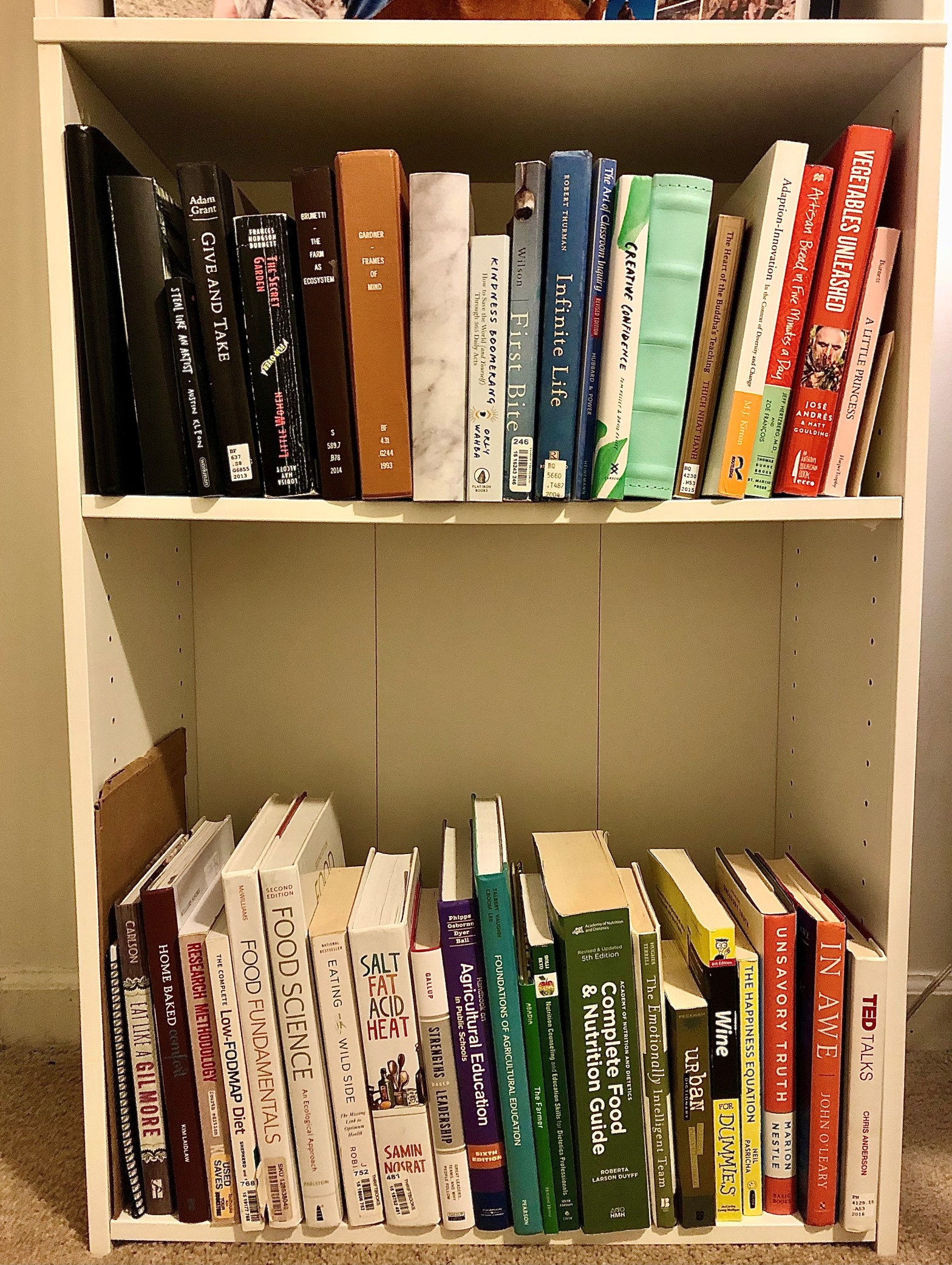
Since starting graduate school at UGA, I find I almost always have at least 15 books checked out at any given time. Some are for class, some for research, others for inspirational reading, and still others for pleasure reading. The ones I have for inspirational reading, well, I almost always start dog-earring the pages filled with those idea souvenirs, which, I know, with library books is a poor habit.
So I started buying them.
My desk, windowsills, and single bookshelf are full of books, and my wallet usually pleads with me to just make a couple of notes on paper and move on rather than searching a website (albeit thrift books) for the eighth time that week to see what bargain deal I can find. But Seth Godin was right. Books – and podcasts – are souvenirs to ideas.
I consumed (or rather, still consume in general) an incredible amount of information while writing On Happiness. So many things I listened to struck a chord, so I started saving them to a playlist, a playlist I so entitled “idea souvenirs” because I was enamored with the concept of being able to travel back to the moment in time that I heard something that entirely changed my perspective.
Many different voices make up this playlist: Neil Pasricha, Dan Pink, Adam Grant, Tom Kelley, Scott Barry Kaufman, Brené Brown, Mihalyi Csikszentmihalyi, Elizabeth Gilbert, Susan Piver, and so many more. Many of these individuals I became familiar with – unsurprisingly – because of listening to the Good Life Project. These guests almost always recommended another author, or were authors themselves, so I was almost always requesting something. I also listened to just about any other podcast I could find with that individual as the host or interviewee. While working on this project specifically, though, I collected a few quotes that particularly drove my autoethnographic explorations:
I am a huge adventure-fiend (surprising, I know, given the entire section on wanderlust). I frequently drive solo across the country. On one such trip, I was heading toward Nashville to stay with some friends after having left another friend in Chicago earlier that morning. At one point, I was in the middle of Indiana and found myself parked at a stoplight during rush hour traffic, so I turned on an episode of the Good Life Project. This episode featured Austin Kleon, but I was initially intrigued because the word “creativity” was in the title.2 I wanted to get the gears turning in preparation for my summer class on creativity that, at the time, was starting in a couple of weeks. Within seconds of listening, I was sold. I learned that Kleon is a pretty talented author and artist, but even beyond that, I felt so soothed by his words and gentle, subtle reminders to be kind to those around us. What really struck me, though, was when he said,
“Creative work runs on uncertainty.”
When we are creating – when we are manifesting our passions, our interests – it’s important to not worry about others. As he mentions, you do not know if what you’re working on – a class assignment, an article for publication, a new song, a piece for an art exhibition, a picture and corresponding witty caption for Instagram – will receive the acclaim, attention, or worth it deserves. But so what? As both Fields and Kleon elucidate, a piece of wisdom I equally aspire to remember,
You are not defined by the number of social media likes you receive.
You are more than a number configured by an unemotional-driven, technological-disseminating algorithm.
Technology is not empathetic: it does not care. But that does not matter. You matter, your work is important. The reaction you receive may be unexpected, but when you are creating, discern for whom and why you are doing such, and if it fails, remember the true beauty is in learning where your ideas can be strengthened.
You may still be asking, “why creativity?” My class aside, or maybe because of all I learned throughout my class, I believe creativity is interwoven into almost everything. Creativity allows us to dream, to make connections, to notice.
Which brings me to the second bit of words I found to be highly enlightening:
“The first step to gratitude is noticing, you can’t be thankful for something that you don’t notice.”
A.J. Jacobs
If you’ve never heard of A.J. Jacobs, you should look him up – he has a wildly fascinating life, driven, seemingly, by whims of creative ideas. He has written about a lot of these ideas, but I actually first came across him on TED Radio Hour. I have since read his book Thanks a Thousand: A Gratitude Journey and listened to him on several other podcast shows. And while this offering from Jacobs is such an incredible example of “well, duh,” I find it an invaluable reminder to
Seek the simple goodness of what already exists around us.
When you look at it that way, it’s hard not to be awestruck by the potential impact and immensity of even the simplest of ideas.
Speaking of awe, have you ever heard of Neil Pasricha or John O’Leary? If you haven’t, I recommend finding Pasricha’s book The Happiness Equation: Want Nothing + Do Anything = Have Everything and O’Leary’s book In Awe: Rediscover Your Childlike Wonder to Unleash Inspiration, Meaning, and Joy and reading them. Right now.
But seriously. I could say so many good things about both of these authors.
I learned about Neil Pasricha first. He was the guest on a podcast episode of Ologies with Alie Ward, an episode in which she dives into the subject of Awesomeology, or the -ology of awesome, as well as the science of gratitude. (I really thought that was the coolest word I had ever heard.) Pasricha discusses so many eye-opening ideas, but I’ll refrain from copying the entire transcript and instead present you with a list of summarized ideas:
- Happiness is a ton of work.
- In fact, a wonderful definition I’ve heard but since forgotten where (it was probably on that same podcast episode, to be honest), is that happiness is what you find (and lose, and find, again and again and again) when you are working for something that represents the entirety of your being.
- Remember the saying, “If you love your job, you’ll never work a day in your life?” Yeah, the above definition is that quote.
- The 3 A’s of Awesome, as said by Neil Pasricha, are Attitude, Awareness, and Authenticity.
- You should absolutely go find the TED Talk (it’s simply called “The 3 A’s of Awesome” and was presented at TEDxToronto), but let me now turn to John O’Leary, an author I think entirely captures the second A, Awareness.
- We must embrace a childlike sense of wonder, or awe, to see the world anew, to see the world as we once saw it – full of magic, surprise, beauty, and hope. Because when we constantly see things in a new light, when we say “yes” to life, nothing is impossible.
- “Raw, unadulterated joy – for everything.” – John O’Leary
I think words have just as much magic and power as the experience of meeting a stranger who reopens your eyes to the goodness and perspective of the world. And if that’s true, which I just told you I thought it was, then I have never felt more magic and power than when listening to these two wonderful humans.
I love ideas.
This is not to say that all ideas are good, though. Some ideas can be very, very bad. But in general, that is not the point of my writing, or my thinking, to be honest with you.
I love the idea that ideas can be our souvenir to an old version of ourselves – you will never be the same person you were when you first heard that idea, and to think that that version of you was the only one to bear witness to the incredible “aha!” within, well, that’s pretty cool.
But ideas are more than these souvenirs. Sometimes they are the key or ticket to some destination all along. They are not so much a reminder of the place or time or idea, but rather the thing to the next place or time or idea. (Imagine that – an idea to an idea! The mind is a wonderous thing.)
As of late, I have been reading TED Talks by Chris Anderson. Early in the book, Anderson writes that ideas are ours for taking. Even if our idea varies from the initial intent of what was disclosed, that’s okay. Ideas are fluid, ever-changing, and uniquely informed. From the second someone presents us with a smidgen of an epiphany, the journey that idea takes us on is then simultaneously ours for the keeping.
I have a friend who loves a good quote. I never really understood why because I thought quotes were an overused attention-grabbing mechanism. Yet here I am, giving you pages and pages of things I have read because they ignited a fire within me. But I think I finally get why he is so taken by quotes:
When you find a good one, you realize,
“This is it. This is what I’ve been trying to say. This is a piece of me.”
Hopefully, somewhere amid my rambling, you found something equally powerful and striking. But if you didn’t, that’s okay. Promise me one thing, though, once you find a good quote, write it down. Remember it, embody it, live it.
The last thoughts I’ll leave you with come from the book Creative Confidence by Tom Kelley and David Kelley.
They talk a bit about something their friend Steve Jobs said. One section in particular resonated quite deeply with me. I think it also highlights the ultimate importance of why you should always, always have faith in uncertainty, notice the small things, seek wonder, and create meaning. They write:
Be you, always.
“You can achieve audacious goals if you have the courage and perseverance to pursue them.”
But above all,
Make your dent in the universe.
Make everyone, especially yourself, know that you are capable of manifesting the ideas that so drive you in the first place.
Notes
 ON HAPPINESS