
There is this concept – I mentioned it earlier – called self-authorship.
It was coined by Robert Kegan back in the 1990s1 and later expanded upon by Baxter Magolda.2 Essentially, both talk about the development of one’s inner voice. This can also be thought of as the voice of internal reason you develop as a result of dealing with differing viewpoints, those external sources of advice and thoughts that do not match the values in your mind.
There are three steps within the self-authorship process, which exist on a continuum. At different times in your life, you may move in and out of each step.
The first is external voice, which simply means you are guided by, or listen to, others. Many of us find ourselves in this phase when we are younger, usually when we are learning about the world and asking questions about what to think or about what is good or bad. Our external voices are our role models – these people are the ones we look to as an example for our own lives.
Sometimes in this learning journey we call life, we discover conflicting thoughts, both among those who are our role models as well as among those in our minds, lessons we have learned from our own experiences. This is known as the “crossroads” phase. In this second phase, you may experience emotional turmoil as you seek to make sense of actions or words that go against the beliefs and values important to you. This is a difficult phase, especially if you are facing systems issues plagued with varying viewpoints. Nonetheless, eventually, with time and thought, you make your way out of this crossroads and into the third phase: inner voice.
The third phase is coined “inner voice” because this is the point at which you listen to your subconscious to make decisions. Sure, you may seek advice from others (external voice) to gather information and make your decision, but sometimes you encounter conflicting views (crossroads), so you ultimately decide on what best reflects the path you have chosen for yourself (inner voice).
For lack of better terms, the more often you listen to your own heart, the more likely you are to be firmly planted within the final stage –
this is the point at which you become self-authored.
There will be times when you still encounter external voices and crossroads, but ultimately, finding yourself is the point at which you live by the view you hold of the world.
While I could likely ramble on and on about my wild fascination with the different paths individuals take to get here, I think my captivation lies in the fact that becoming self-authored means
You have found the version of yourself you are most proud of, the one that is the absolute best person to take care of you and guide you through life, the one that is entirely confident in you as a unique and individual person as well as the story you have to share.
And that’s pretty cool.
Sometimes – scratch that – most of the time I know I am still working on my journey of self-authorship.
And that is very fine with me.
I know I learn things every day – some things are small and require less thought to compartmentalize. But others are large and require a lot of grappling, reflection, and growth.
Self-authorship hinges on personal growth, though, and I think we should always be seeking how to grow into better versions of ourselves.
For years, I have heard friends and family tell me how proud they are of the growth they’ve watched me undergo:
When I was in undergrad and my friends told me they were proud to have watched me come out of my shell and realize there was more to life to school, and again when I decided to diverge a bit and move to a farm in the middle of rural Alabama;
When I was in Alabama and my friends told me they were proud to have witnessed me successfully use my verboseness to (politely) address issues that mattered to me, and again when they asked to be a part of my weekly journal email chain;
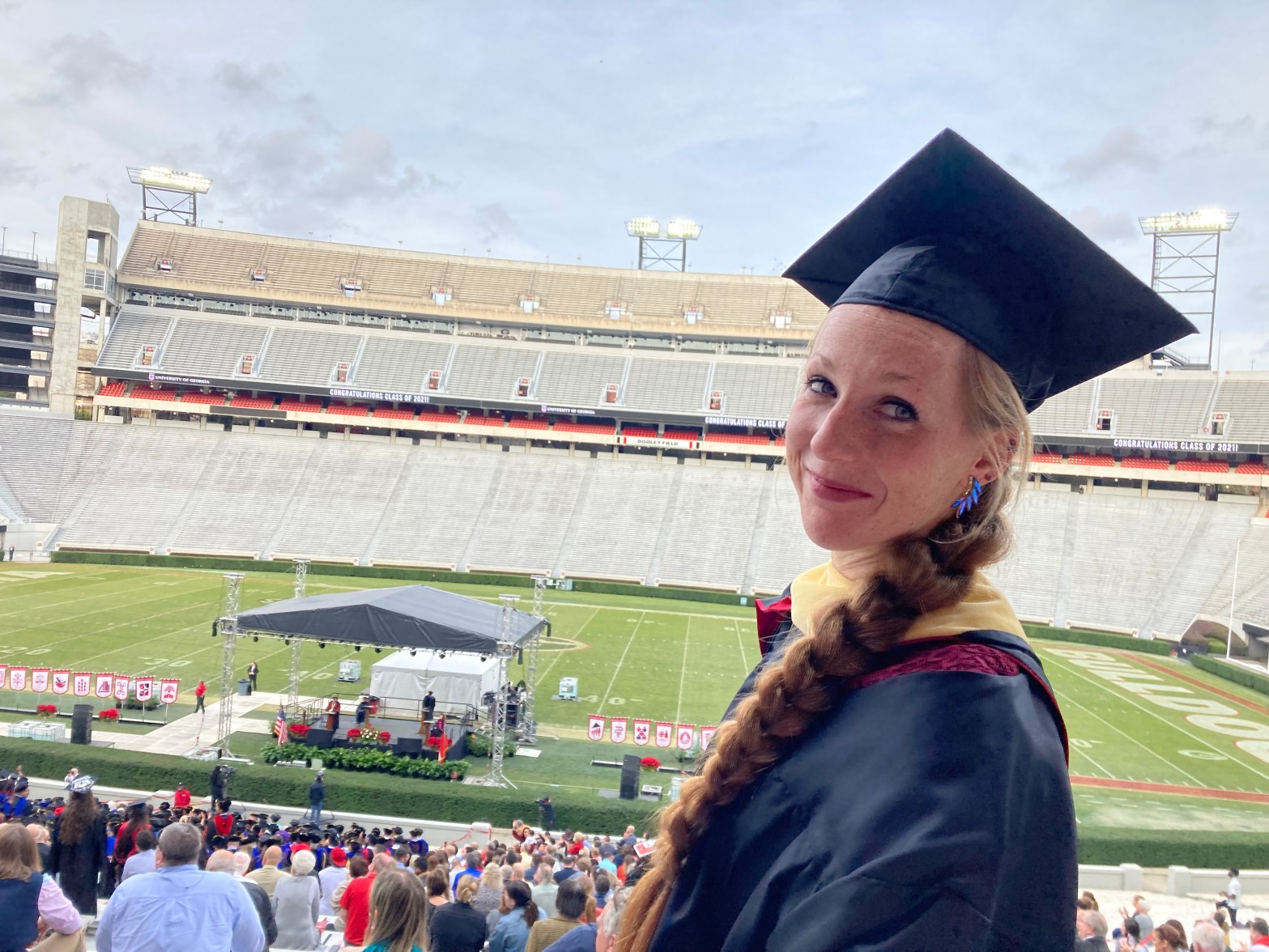
And finally, in Georgia, when my friends and professors told me they were proud to have watched me overcome heartbreak, loss, and loneliness and really grow into myself.
Though I fully believe everyone’s extensions of pride are most certainly compliments, every once in a while I pause and worry – was I too immature or not good enough prior?
Absolutely not.
In these moments, I remind myself – and I think this is an important reminder for anyone – you are always good enough.
I think more so what they meant is that they were proud to have watched me go through an extraordinarily difficult challenge and emerge on the other side – for the better – more confident, sure, and loving of myself. And if you also have people like this on your side, I think that is an immensely powerful realization that should move you to tears.
Friends, family – people – are so loving, it’s downright incredible.
Throughout this self-authorship, inner-voice, finding-you journey, be prepared to love yourself – and find ways to extend that love to yourself. Because when you do emerge on the other side of whatever it is you are facing, there will be an utterly remarkable moment of reckoning when you realize you certainly accomplished what you never thought possible.
You know, in a way, I think On Happiness more so documents my path of self-authorship than anything else – it is my full story thus far.
When I was in high school and college, I was always on the go – working, volunteering, signing up when I didn’t have time, reading my textbooks – all because I was impressed upon that’s what you had to do.
Note: this is not untrue, but there is more than one way to succeed, I just never fully recognized this back then.
And, as I mentioned, for years people have been telling me I am a “ray of sunshine,” “a sun in person form.” These were my external voices, the voices I relied on to tell me I was doing what I needed to do.
But what about what I wanted? What about those moments when I wasn’t sure if I was doing the right thing? If I was really the happy, smiling presence everyone told me I was?
That was my crossroads, my wanderlustfulness, my adrenaline for living, if you will. I was always doing what I thought I had to do, especially while in school. But I found an immense sense of adventure and I embraced (planned) spontaneity while in Alabama.
I know I likely talk about Alabama far too much, but I feel incredibly indebted to my experiences and the people there for helping me find such a part of myself, for helping me learn to be more confident in myself, and maybe, just maybe, if I share my gratitude, I can do justice to those, and all of my, lived experiences.
Along the way – through it all, as I talked about above – I found growth. I embraced it, sought it, remarked at it, cried about it, felt love for it. I found my inner voice and I truly think that is one of the best gifts you could ever give – and receive – for yourself.
When I was in Alabama (shocker, but actually, I accidentally typed that without meaning to be facetious to prior chapters), I often unknowingly wrote about inner voice. In one such instance, I relate the power of your unique perspective to your story – to being confident in what you have to share, even if it appears, to you, seemingly uninteresting.
I had just flown back from Arizona, from a mini-vacation spent with my sister and grandparents – actually, this was right when coronavirus shut down the United States. Covid-19 aside, that week I felt compelled to write about a sermon we had heard while at church on Sunday:
The sermon was titled “A Story Worth Celebrating,” in which the main point was that everyone has something unique to share.
With the incredible advent of technology and the startlingly large presence of mass media, I think it is quite easy to feel insignificant. In college, too, I remember the sense of competition that seemed to dominate many conversations and draw attention away from peoples’ purely unique and individual experiences.
I, like anyone else who was a graduating senior this time last year (or any year, really), had a million things going on – class, internship, research, volunteer work, off-campus job, and of course, some social activities, exercise, and a semblance of mealtimes thrown in here or there.
Looking back, I could have done a lot less of the former things and more of the latter and still thrived (see: my time in AL as an example).
But.
I did find a lot of comfort and stories worth sharing from my off-campus job – I worked as a waitress in an independent living community, serving in the 11th-floor dining room that overlooked the skyline of Fort Worth. (I am quite certain it was the best job I have had.) At the time, I vaguely had the thought that being a waitress certainly wasn’t the most glamorous job, although, I was always sure my workplace was. I often came home with story after story – I love talking, interacting, moving fast, and feeling productive, so I certainly thrived in my work atmosphere.
At this point, I feel like I have taken entirely too long to get to my actual point, but I do miss this job and love reminiscing about ‘the good ole days.’
Anyways. All this to say, social media and popular opinion should not be the sole dictator of what makes up a good story. Everyone has a unique skill set and perspective that most definitely has a place at the table.
Some weeks, I sit here and type out this email to my ~followers~ but let’s be real, sometimes it isn’t all that interesting. That’s okay.
Your story doesn’t have to be anything astonishing, unbelievable, or sparkly. The whole point of telling your story is to inspire internal and external reflection, and maybe, just maybe, learn something cool about yourself along the way.
To be really over the top, let your excitement get others excited – life is much better if you don’t care and allow a bit of pride for what you have accomplished because there is no way anyone should ever tell you that you aren’t enough.
3.15.20
I look back on this entry relatively frequently. And I am astonished. But also comforted.
I am comforted knowing there will be days when the most exciting thing that will happen is waking up to the sun. And then nothing else will happen. And conversely, there will be days that are so extraordinary I cannot believe I was the one to live it. We all experience these opposing types of days. And that is okay – life is made up of tiny moments, remember?
Be proud of these boring days, adventurous days, sad days, wondrous days, startling days, awesome days. Be proud to share your story, your voice, your input, your conflicting thoughts.
Because at the end of the day, you matter.
Never, ever forget that.
Notes
- For more, check out Robert Kegan’s seminal work, In Over Our Heads: The Mental Demands of Modern Life (1994).
- For more, check out Marcia Baxter Magolda’s work, Making Their Own Way: Narratives for Higher Education to Promote Self-Development (2001).


 ON HAPPINESS